Zero-Tariff Export from Thailand
A Practical Guide for Foreign Investors
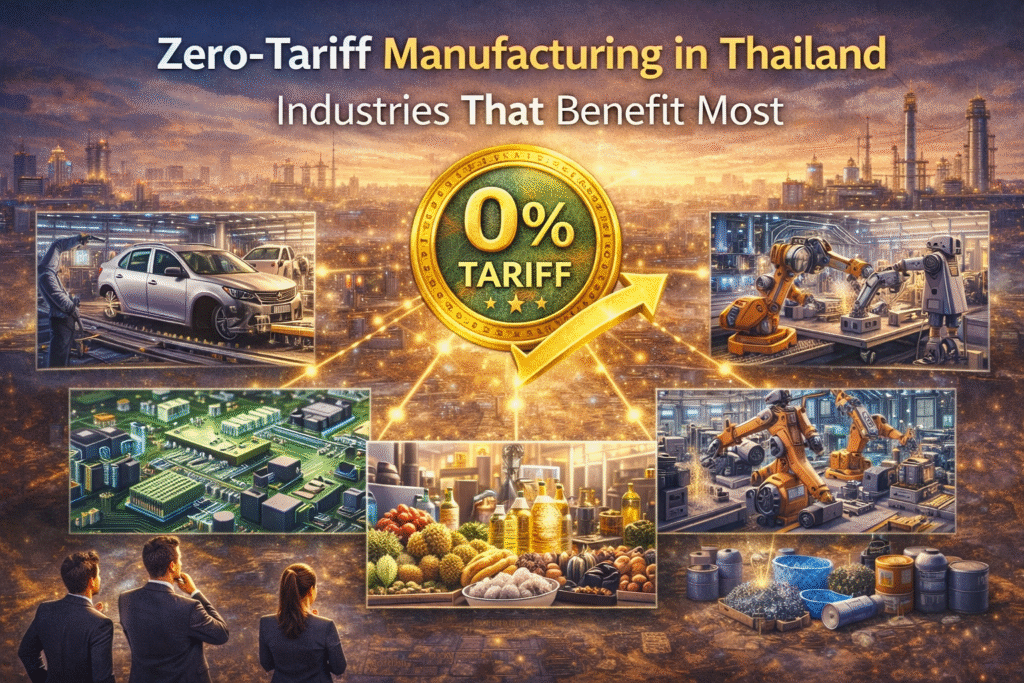
EP 7: Zero-Tariff Manufacturing in Thailand: Industries That Benefit Most
After understanding FTAs, Rules of Origin, and structural alignment, the next logical question for investors is:
Which industries benefit most from zero-tariff manufacturing in Thailand?
Not all sectors gain equally from Thailand’s FTA network.
Zero-tariff advantage depends on:
- Regional demand
- Supply-chain integration
- Origin qualification feasibility
- Tariff differentials in destination markets
Some industries are structurally better positioned than others.
1. Automotive and Auto Parts
Thailand is often referred to as the “Detroit of Asia.”
Why this sector benefits:
- Deep regional supply-chain integration
- Strong ASEAN and Japan linkages
- Mature component ecosystem
- Established origin planning frameworks
Automotive exports to ASEAN, Japan, Australia, and RCEP markets frequently benefit from 0% tariff treatment, provided origin thresholds are met.
Strategic strength:
High transformation value makes Rules of Origin easier to satisfy compared to simple assembly industries.
2. Electronics and Electrical Components
Electronics manufacturing in Thailand is deeply embedded in regional production networks.
FTA advantage applies particularly to:
- Components and sub-assemblies
- Industrial electronics
- Consumer electronics parts
Under regional frameworks such as RCEP, accumulation of origin allows inputs from multiple member countries to qualify.
Strategic strength:
High integration with Asian supply chains enables flexible sourcing while preserving origin eligibility.
3. Machinery and Industrial Equipment
Industrial machinery, precision tools, and capital equipment often benefit from:
- Strong tariff differentials in importing countries
- Substantial manufacturing transformation
- Clear HS classification changes
This sector is well-suited for Change in Tariff Classification (CTC) origin rules.
Strategic strength:
Transformation-heavy production supports defensible zero-tariff claims.
4. Processed Food and Agricultural Products
Thailand’s agricultural base provides a natural advantage for:
- Processed foods
- Agricultural exports
- Value-added food manufacturing
In ASEAN and selected Asia-Pacific markets, many products enjoy zero or reduced tariffs.
However, origin compliance requires:
- Traceability
- Ingredient sourcing transparency
- Strict documentation
Strategic strength:
High regional demand and relatively straightforward origin rules when raw materials are locally sourced.
5. Chemicals and Plastics
Thailand has a developed petrochemical and plastics industry.
Zero-tariff benefits often apply to:
- Intermediate chemical inputs
- Plastic components
- Industrial resins
This sector benefits from:
- Strong regional demand
- Established industrial infrastructure
- Significant value-added transformation
6. Emerging Sectors: EV, Smart Electronics, and Advanced Manufacturing
Thailand’s policy direction increasingly supports:
- Electric vehicle components
- Battery technology
- Smart devices
- Advanced industrial manufacturing
When aligned with BOI incentives and regional FTAs, these sectors can combine:
- Tax incentives
- Operational facilitation
- Zero-tariff export access
This creates a powerful strategic combination.
Industries That Benefit Less from Zero-Tariff Strategy
Not every sector sees strong tariff advantages.
Limited benefit may occur when:
- Tariff differentials are already low globally
- Manufacturing transformation is minimal
- Heavy reliance on non-FTA inputs makes origin qualification difficult
In such cases, operational efficiency may matter more than FTA positioning.
Why Industry Structure Matters
Zero-tariff success depends not only on sector but on:
- Manufacturing depth
- Sourcing flexibility
- HS code structure
- Target export markets
Two companies in the same industry can have entirely different tariff outcomes based on structural design.
The Strategic Framework Investors Should Use
Before committing capital, investors should assess:
- Which export markets are targeted?
- What tariff differential exists without FTA benefits?
- Can origin thresholds realistically be met?
- Does the manufacturing model support substantial transformation?
- How do BOI, FBL, and FTA align within the sector?
Zero-tariff manufacturing is most powerful when sector choice and structural design reinforce each other.
How BRW Supports Industry-Specific Zero-Tariff Strategy
At BRW, we help foreign investors:
- Identify industries with strong tariff differentials
- Map sector opportunities against Thailand’s FTA network
- Assess origin feasibility before investment
- Align BOI promotion, licensing, and customs considerations
- Design export-ready manufacturing structures
Zero-tariff advantage is not about industry hype.
It is about measurable structural competitiveness.
At BRW – Boonrawee Co., Ltd., we offer comprehensive legal, business, and property consulting services to support foreign investors and business owners looking to establish and grow in Thailand.
Our services include:
- Helping you understand and comply with Thai property and land ownership laws.
- Company registration and structuring for business and property purposes.
- Applying for BOI or IEAT promotions if land ownership or special privileges are needed.
- Drafting and reviewing land lease agreements to ensure legal protection.
- Finding suitable land or property locations that match your business needs (factory, office, or commercial spaces).
- Advising on site selection for business operations, including industrial estates, office buildings, and commercial zones.
- Providing architectural design and construction services for buildings, offices, and factories, including customized designs to meet specific business requirements.
- Coordinating with professional architects, engineers, and contractors to ensure your building project complies with Thai laws and standards.
📞 Contact BRW today for expert advice and a one-stop solution to establish your business and property in Thailand!
Read more from Zero-Tariff Export from Thailand
- EP 1: What Is “Zero-Tariff Export” and Why Investors Choose Thailand
- EP 2: Which Countries Import Goods from Thailand at 0% Tariff
- EP 3: Thailand FTA Network: Markets Where Zero-Tariff Access Is Possible
- EP 4: BOI, FBL, or FTA? Choosing the Right Path for Tariff-Free Exports
- EP 5: Rules of Origin Explained: How Products Qualify for 0% Import Duty
- EP 6: Can Trading or Service Companies Benefit from Zero-Tariff Exports?
- EP 7: Zero-Tariff Manufacturing in Thailand: Industries That Benefit Most
- EP 8: Exporting from Thailand to the U.S.: GSP, Tariffs, and Reality
- EP 9: Common Mistakes That Cause Zero-Tariff Benefits to Be Rejected
- EP 10: How to Structure a Thailand Company for Legal Zero-Tariff Exports