Zero-Tariff Export from Thailand
A Practical Guide for Foreign Investors
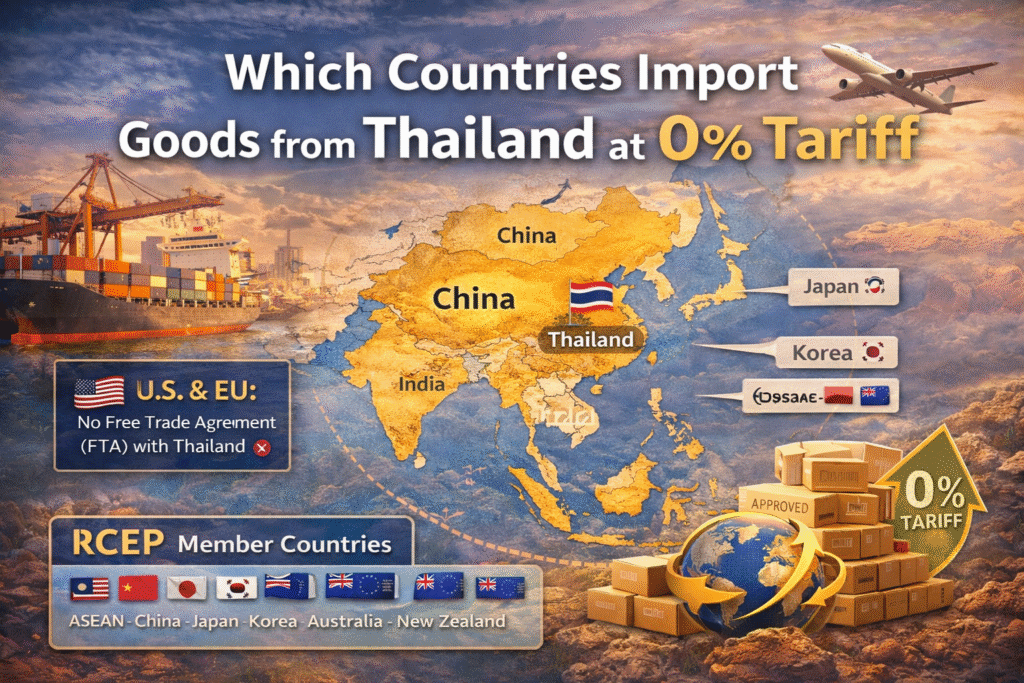
EP 2: Which Countries Import Goods from Thailand at 0% Tariff
One of the most common questions foreign investors ask before setting up manufacturing or export operations in Thailand is:
“Which countries can import goods from Thailand at zero import duty?”
The short answer is: many—but not automatically.
Thailand’s zero-tariff export potential comes from its extensive Free Trade Agreement (FTA) network, not from unilateral exemptions. Understanding where zero tariffs are possible—and under what conditions—is critical for any export-driven investment decision.
Zero-Tariff Exports: A Conditional Benefit
Goods exported from Thailand may enter certain countries at 0% import duty only if they:
- Fall under the relevant FTA tariff schedule
- Meet Rules of Origin
- Are supported by proper trade documentation (e.g., Certificate of Origin)
- Are exported by a structure that can legally claim the benefit
With that context, below are the key countries and regions where zero-tariff imports from Thailand are commonly available.
1. ASEAN Countries (Near-Complete Zero Tariff)
Under the ASEAN Free Trade Area, Thailand enjoys near-complete tariff elimination across the region.
Countries:
- Singapore
- Malaysia
- Indonesia
- Philippines
- Vietnam
- Cambodia
- Laos
- Myanmar
- Brunei
Key characteristics:
- Most goods: 0% import duty
- Simplest and most widely used framework
- Ideal for regional distribution and consolidation hubs
For many investors, ASEAN is the first and fastest market to leverage zero-tariff exports from Thailand.
2. China
Through ASEAN–China FTA and broader regional frameworks, many Thai-origin goods enter China at 0% tariff, especially:
- Industrial products
- Electrical and electronic components
- Selected agricultural and processed food products
China remains one of the most strategically important zero-tariff destinations for Thailand-based manufacturers.
3. Japan
Japan is one of Thailand’s most established FTA partners, supported by multiple overlapping agreements.
Zero-tariff access is common for:
- Automotive and parts
- Machinery and equipment
- Electronics and components
Japan’s tariff schedules are detailed and strictly enforced, making proper structuring and documentation essential.
4. South Korea
Under ASEAN–Korea FTA and regional trade arrangements:
- Many industrial goods qualify for 0% import duty
- Frequently used by electronics and component manufacturers
5. Australia and New Zealand
Through the ASEAN–Australia–New Zealand framework:
- A wide range of industrial, agricultural, and food products enjoy zero or near-zero tariffs
- Particularly attractive for food processing and value-added exports
6. Hong Kong
Under the Thailand–Hong Kong FTA:
- Zero tariffs apply to most goods
- Often used as a trading, logistics, and re-export hub
- Strong linkage with investment and services activities
7. RCEP Markets (The Largest Opportunity Set)
Thailand is part of RCEP, the world’s largest trade agreement, covering 15 economies across Asia-Pacific.
RCEP allows:
- Zero or reduced tariffs across multiple markets
- Accumulation of origin, meaning inputs from several member countries can still qualify
- Greater flexibility in supply-chain design
For investors managing multi-country sourcing, RCEP significantly expands zero-tariff potential.
Important Markets Where Zero Tariff Is NOT Automatic
It is equally important to understand where zero tariff does not apply by default.
United States & European Union
- Thailand does not have a direct FTA with the U.S. or EU
- Standard MFN tariffs apply in most cases
- Limited exceptions may exist under special programs (e.g., GSP), subject to product eligibility and policy changes
These markets require separate tariff and trade-program analysis.
A Common Investor Misunderstanding
Many investors assume:
“If we export from Thailand, tariffs will be zero.”
In reality:
- Zero-tariff eligibility depends on destination, product, and structure
- A qualifying product under one FTA may not qualify under another
- Improper use can result in tariff clawbacks, penalties, or audits
Strategic Takeaway for Investors
Thailand offers one of the widest zero-tariff export networks in Asia, but the benefit is:
- Conditional
- Highly technical
- Structurally driven
Investors who plan correctly can achieve long-term tariff efficiency.
Those who assume benefits without structuring often face costly corrections later.
How BRW Supports Export-Driven Investors
At BRW, we help foreign investors:
- Identify which markets can realistically offer 0% tariffs
- Assess product eligibility under relevant FTAs
- Design export-ready company and supply-chain structures
- Align licensing, customs, and compliance requirements
- Reduce post-investment regulatory and tariff risk
Zero-tariff exports begin with strategy, not assumptions.
At BRW – Boonrawee Co., Ltd., we offer comprehensive legal, business, and property consulting services to support foreign investors and business owners looking to establish and grow in Thailand.
Our services include:
- Helping you understand and comply with Thai property and land ownership laws.
- Company registration and structuring for business and property purposes.
- Applying for BOI or IEAT promotions if land ownership or special privileges are needed.
- Drafting and reviewing land lease agreements to ensure legal protection.
- Finding suitable land or property locations that match your business needs (factory, office, or commercial spaces).
- Advising on site selection for business operations, including industrial estates, office buildings, and commercial zones.
- Providing architectural design and construction services for buildings, offices, and factories, including customized designs to meet specific business requirements.
- Coordinating with professional architects, engineers, and contractors to ensure your building project complies with Thai laws and standards.
📞 Contact BRW today for expert advice and a one-stop solution to establish your business and property in Thailand!
Read more from Zero-Tariff Export from Thailand
- EP 1: What Is “Zero-Tariff Export” and Why Investors Choose Thailand
- EP 2: Which Countries Import Goods from Thailand at 0% Tariff
- EP 3: Thailand FTA Network: Markets Where Zero-Tariff Access Is Possible
- EP 4: BOI, FBL, or FTA? Choosing the Right Path for Tariff-Free Exports
- EP 5: Rules of Origin Explained: How Products Qualify for 0% Import Duty
- EP 6: Can Trading or Service Companies Benefit from Zero-Tariff Exports?
- EP 7: Zero-Tariff Manufacturing in Thailand: Industries That Benefit Most
- EP 8: Exporting from Thailand to the U.S.: GSP, Tariffs, and Reality
- EP 9: Common Mistakes That Cause Zero-Tariff Benefits to Be Rejected
- EP 10: How to Structure a Thailand Company for Legal Zero-Tariff Exports