Zero-Tariff Export from Thailand
A Practical Guide for Foreign Investors
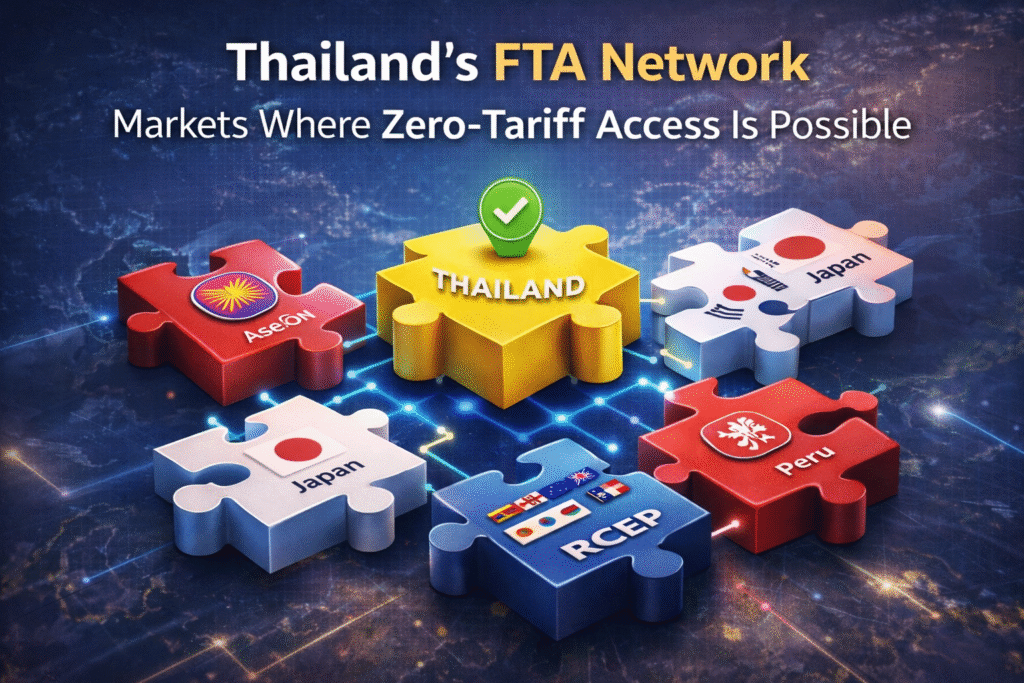
EP 3: Thailand FTA Network: Markets Where Zero-Tariff Access Is Possible
When foreign investors look at Thailand as a manufacturing or export base, the key advantage is not cost alone—it is market access.
Thailand has one of the most comprehensive Free Trade Agreement (FTA) networks in Asia, allowing goods produced in Thailand to enter multiple markets at zero or near-zero import tariffs, provided the correct conditions are met.
Understanding which markets are covered—and how they connect—is essential before making any export-driven investment decision.
Thailand’s FTA Network at a Glance
Thailand’s trade agreements can be grouped into three strategic layers:
- ASEAN Free Trade Area
- ASEAN “Plus” FTAs (China, Japan, Korea, Australia–New Zealand, India)
- Regional and bilateral frameworks (RCEP, Japan, Hong Kong, others)
Each layer expands the range of markets where zero-tariff imports from Thailand are possible.
1. ASEAN: The Foundation of Zero-Tariff Trade
Under the ASEAN Free Trade Area, Thailand enjoys near-complete tariff elimination with all ASEAN member states.
Markets include:
Singapore, Malaysia, Indonesia, Philippines, Vietnam, Cambodia, Laos, Myanmar, and Brunei.
Why ASEAN matters to investors
- Simplest and most predictable tariff framework
- High acceptance rate for 0% tariff claims
- Ideal for regional distribution hubs
- Often the first market where investors realize immediate tariff savings
For many investors, ASEAN is the entry-level proof of concept for zero-tariff exports from Thailand.
2. ASEAN “Plus” FTAs: Expanding Beyond Southeast Asia
Thailand’s ASEAN-based FTAs significantly extend tariff-free access to major economies.
China
Through ASEAN–China arrangements, many Thai-origin goods—especially industrial and intermediate products—can enter China at 0% tariff.
Japan
Japan is supported by:
- ASEAN–Japan FTA
- Thailand–Japan Economic Partnership Agreement (JTEPA)
These agreements are heavily used in automotive, electronics, and machinery supply chains.
South Korea
ASEAN–Korea FTA enables tariff-free or reduced-duty access for a wide range of industrial goods.
Australia & New Zealand
The ASEAN–Australia–New Zealand framework provides strong zero-tariff access, particularly for:
- Food and agricultural products
- Processed goods
- Industrial exports
These markets are often overlooked but offer high regulatory stability.
3. RCEP: The Largest Zero-Tariff Opportunity Set
Thailand is a founding member of RCEP, the world’s largest trade agreement.
RCEP includes:
- All ASEAN countries
- China, Japan, South Korea
- Australia and New Zealand
Why RCEP is transformational
- Covers roughly 30% of global GDP and population
- Allows accumulation of origin, meaning inputs from multiple member countries can still qualify
- Increases flexibility in regional supply-chain design
- Reduces tariff fragmentation across Asia-Pacific
For investors sourcing components from multiple countries, RCEP often makes Thailand a natural consolidation and export platform.
4. Bilateral FTAs: Targeted Market Access
Beyond regional frameworks, Thailand has bilateral FTAs with select partners, including:
- Japan (deep, sector-specific coverage)
- Hong Kong (strong linkage with trade, logistics, and investment)
- Chile and Peru (gateways into Latin America)
While narrower in scope, these agreements can provide strategic niche advantages for certain products and industries.
Markets Where Zero-Tariff Is Not Automatic
It is equally important to understand the limits of Thailand’s FTA network.
- United States
- European Union
- United Kingdom
Thailand does not have direct FTAs with these markets.
Standard MFN tariffs apply, with limited exceptions under special programs (e.g. GSP), subject to product eligibility and policy changes.
These destinations require separate tariff and compliance analysis.
A Common Investor Misunderstanding
Many investors believe:
“If Thailand has many FTAs, zero tariff should be easy.”
In reality:
- Each FTA has its own tariff schedules
- Rules of Origin differ by agreement
- A product qualifying under one FTA may fail under another
- Documentation and structure are scrutinized during customs audits
The network creates opportunity, but structure determines usability.
Strategic Takeaway for Investors
Thailand’s FTA network offers:
- Broad market access
- Significant tariff-saving potential
- Strong regional integration
However, zero-tariff access is achieved only when:
- The correct FTA is selected
- Products qualify technically
- Company and supply-chain structures are designed accordingly
Investors who plan FTA usage after operations begin often face delays, rejections, or restructuring.
How BRW Supports FTA-Driven Investment Strategies
At BRW, we help foreign investors:
- Map target export markets against Thailand’s FTA network
- Identify which agreements are realistically usable
- Design export-ready legal and operational structures
- Align licensing, customs, and tax considerations
- Reduce long-term tariff and regulatory risk
Zero-tariff access is not about choosing the right country—it is about designing the right structure.
At BRW – Boonrawee Co., Ltd., we offer comprehensive legal, business, and property consulting services to support foreign investors and business owners looking to establish and grow in Thailand.
Our services include:
- Helping you understand and comply with Thai property and land ownership laws.
- Company registration and structuring for business and property purposes.
- Applying for BOI or IEAT promotions if land ownership or special privileges are needed.
- Drafting and reviewing land lease agreements to ensure legal protection.
- Finding suitable land or property locations that match your business needs (factory, office, or commercial spaces).
- Advising on site selection for business operations, including industrial estates, office buildings, and commercial zones.
- Providing architectural design and construction services for buildings, offices, and factories, including customized designs to meet specific business requirements.
- Coordinating with professional architects, engineers, and contractors to ensure your building project complies with Thai laws and standards.
📞 Contact BRW today for expert advice and a one-stop solution to establish your business and property in Thailand!
Read more from Zero-Tariff Export from Thailand
- EP 1: What Is “Zero-Tariff Export” and Why Investors Choose Thailand
- EP 2: Which Countries Import Goods from Thailand at 0% Tariff
- EP 3: Thailand FTA Network: Markets Where Zero-Tariff Access Is Possible
- EP 4: BOI, FBL, or FTA? Choosing the Right Path for Tariff-Free Exports
- EP 5: Rules of Origin Explained: How Products Qualify for 0% Import Duty
- EP 6: Can Trading or Service Companies Benefit from Zero-Tariff Exports?
- EP 7: Zero-Tariff Manufacturing in Thailand: Industries That Benefit Most
- EP 8: Exporting from Thailand to the U.S.: GSP, Tariffs, and Reality
- EP 9: Common Mistakes That Cause Zero-Tariff Benefits to Be Rejected
- EP 10: How to Structure a Thailand Company for Legal Zero-Tariff Exports