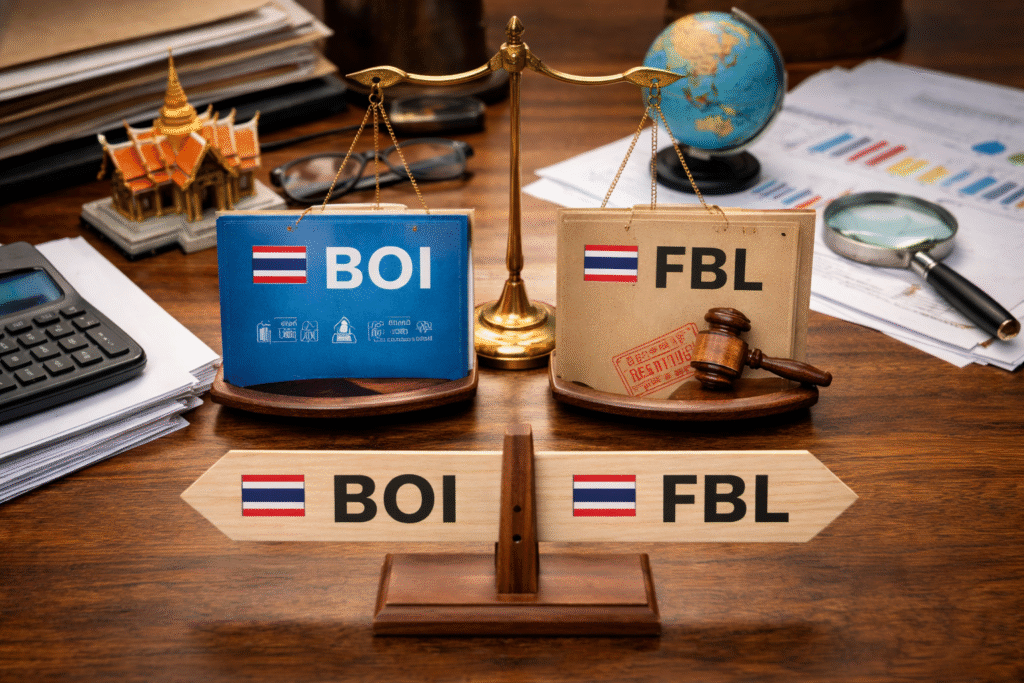
Thailand BOI vs FBL: Which One Foreign Investors Misunderstand Most?
For foreign investors entering Thailand, few decisions are more misunderstood—and more costly—than choosing between BOI promotion and a Foreign Business License (FBL).
Many investors assume these two are interchangeable.
They are not.
Understanding the difference early can determine whether your project moves smoothly—or stalls for months under regulatory scrutiny.
The Common Misconception
“If my business is foreign-owned, I just need BOI or FBL—whichever is easier.”
This assumption is the root of most failed applications.
In reality:
- BOI and FBL serve different regulatory purposes
- They are assessed by different authorities
- And they answer very different questions
What BOI Really Is (and Is Not)
BOI refers to investment promotion granted by the Thailand Board of Investment.
BOI is about:
- National economic benefit
- Industry development
- Technology, innovation, or strategic value
- Job creation and skills transfer
BOI is not:
- A guaranteed approval path
- A workaround for restricted businesses
- A solution for pure service or consulting activities
Many investors misunderstand BOI as:
“A license that allows foreigners to do business freely”
In truth, BOI is selective and policy-driven.
If your business does not align with Thailand’s investment priorities, BOI will not apply—no matter how large the capital.
What FBL Actually Regulates
An FBL (Foreign Business License) is issued under the Foreign Business Act.
FBL is about:
- Permission to operate restricted service or trading activities
- Case-by-case regulatory discretion
- Assessing whether a foreign business is necessary in Thailand
FBL is not:
- Automatic
- Guaranteed by capital size
- A formality handled by templates
Authorities assess:
- Commercial rationale
- Economic necessity
- Revenue structure
- Operational substance in Thailand
This is where many applications fail—not legally, but strategically.
So Which One Is More Misunderstood?
The Answer: FBL
Most investors:
- Underestimate the scrutiny involved
- Assume it is a filing exercise
- Rely on generic consultant templates
- Discover problems only after submission
BOI failures are usually clear early.
FBL failures often occur silently, through delays, endless questions, or quiet rejection.
Why Choosing the Wrong Path Is Expensive
Misclassification can lead to:
- 6–12 months of lost time
- Regulatory dead-ends
- Forced restructuring
- Tax and compliance risks
- Investor confidence erosion
In some cases, businesses qualify for neither BOI nor FBL in their original structure—and must be redesigned entirely.
The Strategic Question Investors Should Ask
Not:
“Which option is easier?”
But:
“Which structure best survives regulatory, tax, and operational scrutiny in Thailand?”
That answer depends on:
- Business substance
- Revenue flow
- Control and governance
- Long-term operating model
Final Perspective
BOI and FBL are not alternatives—they are tools.
Using the wrong tool does not just delay approval; it can undermine the entire investment thesis.
Foreign investors who succeed in Thailand do not chase licenses.
They design regulator-proof structures from the beginning.
💼 How BRW Can Help You with Property and Business in Thailand
At BRW – Boonrawee Co., Ltd., we offer comprehensive legal, business, and property consulting services to support foreign investors and business owners looking to establish and grow in Thailand.
Our services include:
- Helping you understand and comply with Thai property and land ownership laws.
- Company registration and structuring for business and property purposes.
- Applying for BOI or IEAT promotions if land ownership or special privileges are needed.
- Drafting and reviewing land lease agreements to ensure legal protection.
- Finding suitable land or property locations that match your business needs (factory, office, or commercial spaces).
- Advising on site selection for business operations, including industrial estates, office buildings, and commercial zones.
- Providing architectural design and construction services for buildings, offices, and factories, including customized designs to meet specific business requirements.
- Coordinating with professional architects, engineers, and contractors to ensure your building project complies with Thai laws and standards.
📞 Contact BRW today for expert advice and a one-stop solution to establish your business and property in Thailand!