
Zero-Tariff Export from Thailand
A Practical Guide for Foreign Investors
EP 5: Rules of Origin Explained: How Products Qualify for 0% Import Duty
Many foreign investors assume that manufacturing in Thailand automatically qualifies their products for zero-tariff treatment under Free Trade Agreements (FTAs).
This assumption is one of the most common — and costly — misunderstandings.
In reality, zero-tariff eligibility is determined by Rules of Origin, not by factory location alone.
What Are Rules of Origin?
Rules of Origin (ROO) are the technical criteria used by customs authorities to determine where a product legally “originates.”
They answer one critical question:
Is this product genuinely originating from Thailand under the applicable FTA?
Only products that meet the applicable Rules of Origin can:
- Claim preferential tariff treatment
- Enter destination markets at 0% import duty
- Defend that claim during customs audits
Why Rules of Origin Matter More Than Any Incentive
Investors often focus on:
- BOI incentives
- Corporate tax benefits
- Factory location
But customs authorities focus on origin.
A project can be:
- Fully licensed
- BOI-promoted
- Operationally sound
…and still lose zero-tariff benefits if origin rules are not met.
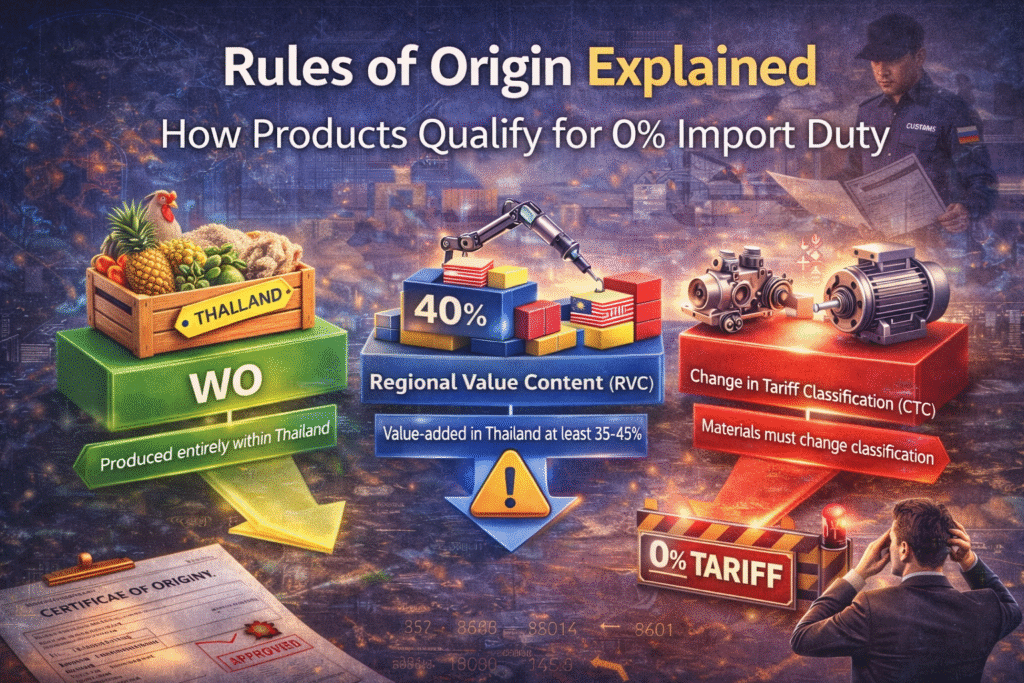
The Three Main Types of Rules of Origin
While details vary by FTA, most Rules of Origin fall into three core categories.
1. Wholly Obtained (WO)
This rule applies to products that are entirely produced in one country.
Typical examples:
- Agricultural products harvested in Thailand
- Minerals extracted in Thailand
Limitation:
WO rules are simple, but apply to a narrow range of products.
2. Regional Value Content (RVC)
RVC requires that a minimum percentage of the product’s value be added within Thailand (or FTA partner countries).
Common thresholds:
- 35%
- 40%
- 45%
Depending on the FTA and product.
Key risk:
Imported materials, transfer pricing, and incorrect cost allocation can easily push the product below the required threshold.
3. Change in Tariff Classification (CTC)
CTC requires that non-originating materials undergo a change in HS code during production.
Examples:
- Change at chapter level (CC)
- Change at heading level (CTH)
- Change at subheading level (CTSH)
This rule focuses on manufacturing transformation, not cost.
Why Many Products Fail Origin Tests
In practice, origin failures usually occur because:
- Key components are imported without sufficient transformation
- Assembly activities are too minimal
- Value-added calculations are incorrect or unsupported
- HS codes are misclassified
- Documentation does not reflect real operations
These issues are often discovered after exports begin, during customs post-clearance audits.
Rules of Origin Are FTA-Specific
A critical but overlooked fact:
A product may qualify under one FTA — and fail under another.
Each FTA has:
- Its own ROO rules
- Its own calculation methods
- Its own documentation requirements
This means:
- A structure optimized for ASEAN may not work for Japan
- A product qualifying under RCEP may fail under a bilateral FTA
FTA selection must therefore be designed together with origin planning.
Origin Is About Substance, Not Paperwork
Customs authorities do not rely solely on certificates.
They assess:
- Actual manufacturing processes
- Sourcing of raw materials
- Cost structures
- Transfer pricing consistency
- Operational substance in Thailand
A Certificate of Origin is evidence — not proof by itself.
A Common Investor Scenario: “Approved, But Rejected”
It is common to see companies that:
- Receive Certificates of Origin
- Export successfully for months
- Later face customs audits
When origin cannot be substantiated:
- Zero-tariff treatment is revoked
- Back-duties are imposed
- Penalties and interest apply
The risk is retrospective — and often underestimated.
Strategic Takeaway for Investors
Rules of Origin are not a compliance formality.
They are a structural design issue.
Zero-tariff success requires:
- Origin planning at the investment stage
- Alignment between sourcing, manufacturing, and FTA selection
- Documentation that reflects operational reality
Designing origin after the factory is built is usually too late.
How BRW Helps Investors Get Origin Right
At BRW, we support foreign investors by:
- Analyzing origin eligibility before investment
- Designing sourcing and manufacturing structures to meet ROO
- Stress-testing RVC and CTC scenarios
- Aligning BOI, FBL, tax, and customs considerations
- Preparing defensible documentation for audits
Rules of Origin do not reward assumptions — they reward preparation.
At BRW – Boonrawee Co., Ltd., we offer comprehensive legal, business, and property consulting services to support foreign investors and business owners looking to establish and grow in Thailand.
Our services include:
- Helping you understand and comply with Thai property and land ownership laws.
- Company registration and structuring for business and property purposes.
- Applying for BOI or IEAT promotions if land ownership or special privileges are needed.
- Drafting and reviewing land lease agreements to ensure legal protection.
- Finding suitable land or property locations that match your business needs (factory, office, or commercial spaces).
- Advising on site selection for business operations, including industrial estates, office buildings, and commercial zones.
- Providing architectural design and construction services for buildings, offices, and factories, including customized designs to meet specific business requirements.
- Coordinating with professional architects, engineers, and contractors to ensure your building project complies with Thai laws and standards.
📞 Contact BRW today for expert advice and a one-stop solution to establish your business and property in Thailand!
Read more from Zero-Tariff Export from Thailand
- EP 1: What Is “Zero-Tariff Export” and Why Investors Choose Thailand
- EP 2: Which Countries Import Goods from Thailand at 0% Tariff
- EP 3: Thailand FTA Network: Markets Where Zero-Tariff Access Is Possible
- EP 4: BOI, FBL, or FTA? Choosing the Right Path for Tariff-Free Exports
- EP 5: Rules of Origin Explained: How Products Qualify for 0% Import Duty
- EP 6: Can Trading or Service Companies Benefit from Zero-Tariff Exports?
- EP 7: Zero-Tariff Manufacturing in Thailand: Industries That Benefit Most
- EP 8: Exporting from Thailand to the U.S.: GSP, Tariffs, and Reality
- EP 9: Common Mistakes That Cause Zero-Tariff Benefits to Be Rejected
- EP 10: How to Structure a Thailand Company for Legal Zero-Tariff Exports