
Zero-Tariff Export from Thailand
A Practical Guide for Foreign Investors
EP 8: Exporting from Thailand to the U.S.: GSP, Tariffs, and Reality
For many foreign investors, the United States is the ultimate export destination.
Large market. Strong purchasing power. Stable legal system.
But when it comes to exporting from Thailand to the U.S., one question dominates:
Can we export at 0% tariff?
The answer is more complex than many expect.
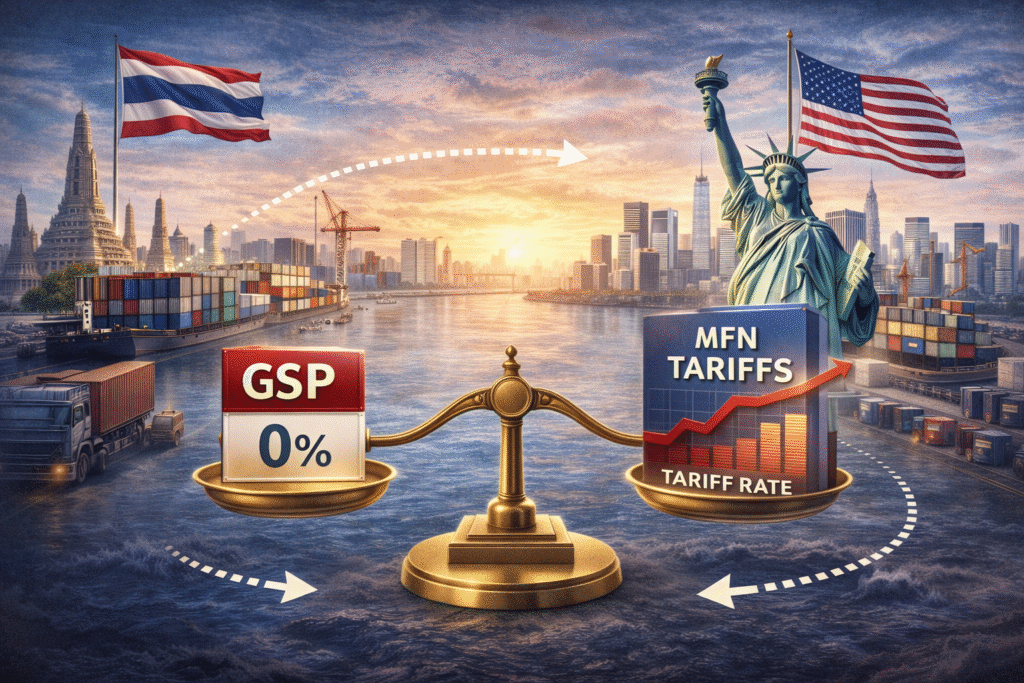
Understanding the difference between GSP, MFN tariffs, and Rules of Origin reality is critical before structuring production in Thailand for the U.S. market.
1. Thailand and the U.S.: No Bilateral FTA
Unlike some countries, Thailand does not currently have a bilateral Free Trade Agreement with the United States.
This means:
- There is no automatic zero-tariff access
- Standard U.S. MFN (Most Favored Nation) tariffs apply
- Preferential treatment depends on specific programs, not FTAs
Investors must therefore look carefully at tariff classification and eligibility frameworks.
2. What About GSP?
The Generalized System of Preferences (GSP) is a U.S. program that provides tariff reductions or elimination for certain products from designated developing countries.
Thailand has historically been a GSP beneficiary — but with important limitations:
- Not all products qualify
- Certain sectors have been suspended in the past
- GSP status is subject to periodic U.S. review
- The program itself has experienced lapses and renewals
Key reality:
GSP is a unilateral U.S. program — not a permanent treaty-based right.
Export strategy cannot rely on assumptions of automatic continuation.
3. When Is 0% Tariff Possible?
Zero tariff may apply when:
- The product is covered under active GSP eligibility
- The product’s MFN tariff rate is already 0%
- A special sectoral exemption applies
However, many industrial and consumer products entering the U.S. are subject to MFN tariffs ranging from low single digits to double digits, depending on HS classification.
4. Tariff Reality: The HS Code Determines Everything
U.S. tariff treatment depends entirely on the product’s HS code classification.
Two products in the same industry may face:
- Completely different tariff rates
- Different trade remedy exposure
- Different eligibility for preference programs
Misclassification can result in:
- Retroactive duty assessment
- Penalties
- Audit exposure
Tariff planning must begin with accurate classification — not marketing descriptions.
5. Rules of Origin Still Matter
Even under GSP, origin qualification is required.
The U.S. evaluates:
- Regional value content
- Substantial transformation
- Direct shipment requirements
- Supporting documentation
Simply assembling imported components in Thailand may not qualify as substantial transformation under U.S. customs standards.
6. Trade Remedies and Additional Duties
Beyond MFN tariffs, U.S. imports may be subject to:
- Anti-dumping duties
- Countervailing duties
- Section 301 measures (depending on supply chain origin)
- Industry-specific trade actions
Tariff strategy must consider not only headline rates — but trade remedy exposure.
7. The Strategic Reality for Investors
Thailand can be a competitive manufacturing base for exports to the U.S. — but not because of automatic zero tariffs.
Success depends on:
- Correct HS classification
- Realistic tariff modeling
- Origin qualification planning
- Trade remedy risk assessment
- Supply-chain transparency
In many cases, tariff differentials are manageable — but only when properly analyzed.
8. The Cost of Getting It Wrong
Improper tariff planning can result in:
- Unexpected duty exposure
- Margin erosion
- Customs disputes
- Delayed shipments
- Reputational risk with U.S. importers
Exporting to the U.S. requires structural discipline, not assumptions.
Strategic Takeaway
Thailand is a strong regional manufacturing platform.
But exporting to the United States is governed by:
- MFN tariff schedules
- GSP eligibility (when applicable)
- Substantial transformation tests
- Trade remedy frameworks
There is no blanket 0% guarantee.
There is only structured, defensible compliance.
How BRW Supports U.S.-Focused Export Strategy
At BRW, we help foreign investors:
- Analyze U.S. tariff schedules before investment
- Assess GSP eligibility and program stability
- Review HS classification accuracy
- Evaluate origin qualification feasibility
- Model duty exposure and trade remedy risk
- Align Thai corporate structure with U.S. import compliance
Export success to the U.S. is not about optimism.
It is about preparation.
At BRW – Boonrawee Co., Ltd., we offer comprehensive legal, business, and property consulting services to support foreign investors and business owners looking to establish and grow in Thailand.
Our services include:
- Helping you understand and comply with Thai property and land ownership laws.
- Company registration and structuring for business and property purposes.
- Applying for BOI or IEAT promotions if land ownership or special privileges are needed.
- Drafting and reviewing land lease agreements to ensure legal protection.
- Finding suitable land or property locations that match your business needs (factory, office, or commercial spaces).
- Advising on site selection for business operations, including industrial estates, office buildings, and commercial zones.
- Providing architectural design and construction services for buildings, offices, and factories, including customized designs to meet specific business requirements.
- Coordinating with professional architects, engineers, and contractors to ensure your building project complies with Thai laws and standards.
📞 Contact BRW today for expert advice and a one-stop solution to establish your business and property in Thailand!
Read more from Zero-Tariff Export from Thailand
- EP 1: What Is “Zero-Tariff Export” and Why Investors Choose Thailand
- EP 2: Which Countries Import Goods from Thailand at 0% Tariff
- EP 3: Thailand FTA Network: Markets Where Zero-Tariff Access Is Possible
- EP 4: BOI, FBL, or FTA? Choosing the Right Path for Tariff-Free Exports
- EP 5: Rules of Origin Explained: How Products Qualify for 0% Import Duty
- EP 6: Can Trading or Service Companies Benefit from Zero-Tariff Exports?
- EP 7: Zero-Tariff Manufacturing in Thailand: Industries That Benefit Most
- EP 8: Exporting from Thailand to the U.S.: GSP, Tariffs, and Reality
- EP 9: Common Mistakes That Cause Zero-Tariff Benefits to Be Rejected
- EP 10: How to Structure a Thailand Company for Legal Zero-Tariff Exports