Zero-Tariff Export from Thailand
A Practical Guide for Foreign Investors
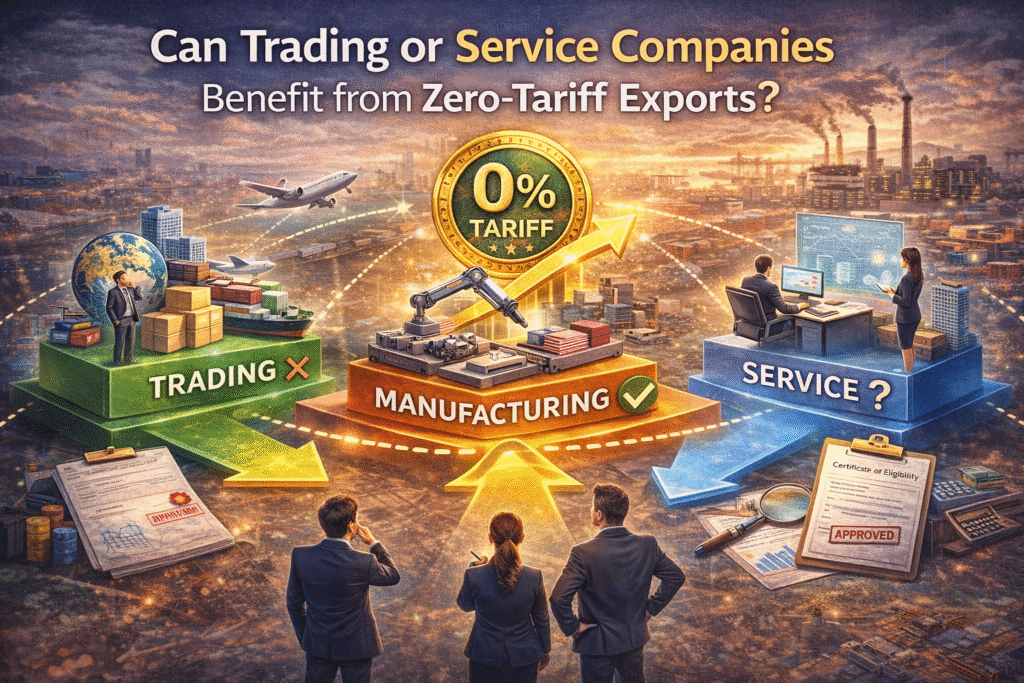
EP 6: Can Trading or Service Companies Benefit from Zero-Tariff Exports?
After understanding Free Trade Agreements (FTAs) and Rules of Origin, many investors ask a critical follow-up question:
“Do we really need to manufacture in Thailand — or can a trading or service company still benefit from zero-tariff exports?”
The answer is nuanced.
In most cases, trading and service companies cannot independently create zero-tariff eligibility — but under the right structure, they can play a strategic role.
Understanding this distinction is essential before choosing a business model.
Zero-Tariff Benefits Are Product-Based, Not Company-Based
FTA benefits apply to products, not corporate registration types.
Zero-tariff treatment depends on:
- Origin qualification
- Manufacturing transformation
- Regional value content
- Proper documentation
A trading license or service registration alone does not generate origin.
This is where many investors misunderstand the system.
Scenario 1: Pure Trading Company
A pure trading company:
- Imports finished goods
- Re-exports them without substantial transformation
In this case:
❌ No additional origin is created
❌ No new tariff benefit is generated
❌ The product retains its original country of origin
If the goods were not originally qualifying for FTA benefits, simply routing them through Thailand does not change that status.
Key principle:
Minimal handling, repackaging, or labeling does not qualify as origin transformation.
Scenario 2: Light Assembly or Processing
Some investors establish operations that:
- Assemble components
- Perform light processing
- Conduct packaging or finishing
The critical question becomes:
Does this activity meet the applicable Rules of Origin under the chosen FTA?
If the activity results in:
- Sufficient Regional Value Content (RVC), or
- A qualifying Change in Tariff Classification (CTC),
then zero-tariff eligibility may be achievable.
If not, the structure remains legally valid — but not tariff-efficient.
Scenario 3: Service Companies Supporting Manufacturing
Service companies can play an indirect but strategic role in FTA utilization.
For example:
- Supply-chain management
- Procurement coordination
- Quality control
- Regional headquarters operations
While these activities do not directly create origin, they can:
- Improve compliance
- Optimize sourcing patterns
- Align operations to meet RVC thresholds
In other words, service entities can support zero-tariff strategies — but not substitute manufacturing substance.
A Common Investor Miscalculation
Many investors assume:
“We can set up a trading company in Thailand and use Thailand’s FTAs.”
This is rarely correct.
FTAs do not reward corporate registration —
they reward economic substance and transformation.
A structure that looks efficient on paper may fail origin qualification entirely.
The Substance Test
Customs authorities evaluate:
- Where raw materials are sourced
- Where value is added
- What manufacturing processes occur
- Whether transformation is meaningful
- Whether documentation matches operational reality
If the answer reveals insufficient substance, preferential treatment may be denied.
When a Hybrid Structure Makes Sense
In some cases, investors combine:
- Manufacturing operations (to generate origin)
- A trading entity (to manage exports and contracts)
- A service entity (to centralize management and support)
This layered structure can work — but only when carefully designed to align with:
- FBL or BOI requirements
- Transfer pricing rules
- Customs compliance
- FTA origin criteria
Improvised hybrid models often collapse under scrutiny.
Strategic Takeaway for Investors
If your goal is zero-tariff export from Thailand:
- Pure trading structures are rarely sufficient
- Service companies alone cannot create origin
- Manufacturing substance is usually required
- Origin planning must precede corporate registration
The question is not whether trading is allowed —
it is whether trading supports a defensible origin strategy.
How BRW Helps Structure It Correctly
At BRW, we help foreign investors:
- Assess whether trading, manufacturing, or hybrid structures are appropriate
- Evaluate whether planned activities meet FTA origin thresholds
- Align FBL, BOI, tax, and customs considerations
- Design defensible export models that withstand audits
- Avoid “legal but non-qualifying” setups
Zero-tariff exports are achieved through structural design, not creative paperwork.
At BRW – Boonrawee Co., Ltd., we offer comprehensive legal, business, and property consulting services to support foreign investors and business owners looking to establish and grow in Thailand.
Our services include:
- Helping you understand and comply with Thai property and land ownership laws.
- Company registration and structuring for business and property purposes.
- Applying for BOI or IEAT promotions if land ownership or special privileges are needed.
- Drafting and reviewing land lease agreements to ensure legal protection.
- Finding suitable land or property locations that match your business needs (factory, office, or commercial spaces).
- Advising on site selection for business operations, including industrial estates, office buildings, and commercial zones.
- Providing architectural design and construction services for buildings, offices, and factories, including customized designs to meet specific business requirements.
- Coordinating with professional architects, engineers, and contractors to ensure your building project complies with Thai laws and standards.
📞 Contact BRW today for expert advice and a one-stop solution to establish your business and property in Thailand!
Read more from Zero-Tariff Export from Thailand
- EP 1: What Is “Zero-Tariff Export” and Why Investors Choose Thailand
- EP 2: Which Countries Import Goods from Thailand at 0% Tariff
- EP 3: Thailand FTA Network: Markets Where Zero-Tariff Access Is Possible
- EP 4: BOI, FBL, or FTA? Choosing the Right Path for Tariff-Free Exports
- EP 5: Rules of Origin Explained: How Products Qualify for 0% Import Duty
- EP 6: Can Trading or Service Companies Benefit from Zero-Tariff Exports?
- EP 7: Zero-Tariff Manufacturing in Thailand: Industries That Benefit Most
- EP 8: Exporting from Thailand to the U.S.: GSP, Tariffs, and Reality
- EP 9: Common Mistakes That Cause Zero-Tariff Benefits to Be Rejected
- EP 10: How to Structure a Thailand Company for Legal Zero-Tariff Exports