Zero-Tariff Export from Thailand
A Practical Guide for Foreign Investors
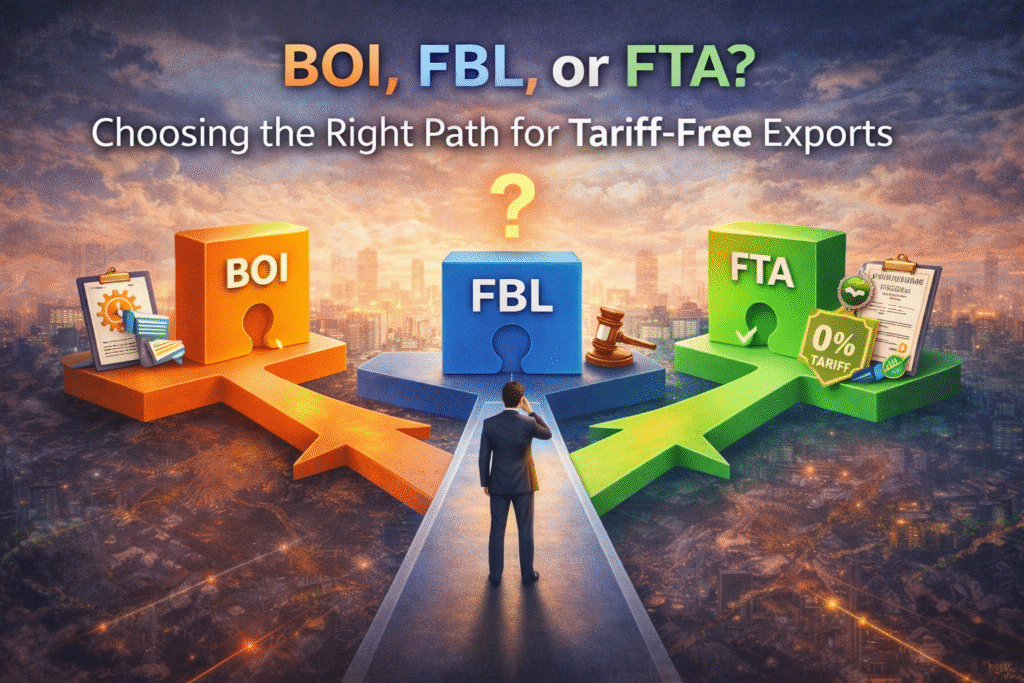
EP 4: BOI, FBL, or FTA? Choosing the Right Path for Tariff-Free Exports
One of the most common — and most costly — mistakes foreign investors make in Thailand is treating BOI, FBL, and FTA as interchangeable options.
They are not.
Each serves a different regulatory purpose, and choosing the wrong path can delay operations, eliminate tariff benefits, or force costly restructuring after investment.
Three Tools. Three Different Questions.
Before deciding which path to take, investors should understand what each tool actually answers.
1. BOI: Should Thailand Promote This Investment?
BOI (Board of Investment) promotion is a policy tool, not a trade tool.
It answers the question:
Does this project contribute to Thailand’s economic and industrial development?
BOI typically provides:
- Foreign ownership permissions (in promoted activities)
- Tax incentives (corporate income tax, import duty exemptions on machinery)
- Facilitation of visas and work permits
- Land ownership rights for promoted projects
BOI does not automatically provide:
- Zero-tariff export rights
- FTA eligibility
- Origin qualification for exported goods
Key insight:
A BOI-promoted company may still fail to qualify for FTA zero-tariff treatment if its products or structure do not meet Rules of Origin.
2. FBL: Is a Foreign Company Allowed to Operate This Business in Thailand?
An FBL (Foreign Business License) is a legal permission, not an incentive.
It answers the question:
Can a foreign-owned entity legally conduct this activity in Thailand?
FBL is relevant when:
- The business falls under restricted categories
- Services or trading activities are involved
- BOI promotion is not applicable
FBL does not provide:
- Tax incentives
- Tariff reductions
- Export privileges by itself
Key insight:
FBL determines whether you can operate — not how cheaply you can export.
3. FTA: Can This Product Enter a Market at 0% Import Duty?
FTA (Free Trade Agreement) benefits are trade privileges, not licenses.
They answer the question:
Can goods produced in Thailand enter a specific market at zero or reduced tariff?
FTA eligibility depends on:
- Destination country
- Product HS code
- Rules of Origin
- Manufacturing and sourcing substance
- Trade documentation (e.g. Certificate of Origin)
Key insight:
FTA benefits apply to products, not companies.
Why Investors Often Choose the Wrong Path
Many investors approach Thailand with assumptions like:
- “If we have BOI, tariffs should be zero.”
- “If we get an FBL, exports will be easier.”
- “FTA will solve licensing issues.”
These assumptions conflate three separate regulatory regimes.
The result is often:
- BOI projects that cannot use FTAs
- FBL companies that cannot export tariff-free
- Structures that are legal but not trade-efficient
The Right Way to Think About BOI, FBL, and FTA
Instead of asking:
Which one should we choose?
Investors should ask:
How do these tools work together for our business model?
A common strategic alignment looks like this:
- BOI or FBL → determines legal right to operate
- Company & supply-chain structure → determines origin qualification
- FTA selection → determines tariff outcome in target markets
None of these steps can be skipped.
Case Insight: “Legal but Not Export-Ready”
It is common to see companies that are:
- Properly registered
- Fully licensed
- Operationally active
…but still unable to claim zero-tariff benefits because:
- Manufacturing substance is insufficient
- Sourcing breaks origin rules
- Documentation does not match actual operations
The structure is legal — but not export-ready.
Strategic Takeaway for Investors
- BOI is about incentives and policy alignment
- FBL is about legal permission to operate
- FTA is about tariff treatment of products
Zero-tariff exports are achieved only when all three are aligned correctly — from the start.
Fixing misalignment after investment is often expensive, slow, and risky.
How BRW Supports the Right Path from Day One
Determine whether BOI or FBL is appropriate (or neither)
- Design company and operational structures with FTA eligibility in mind
- Align licensing, tax, customs, and trade considerations
- Avoid “legal but unusable” export structures
- Build defensible zero-tariff strategies that survive audits
Zero-tariff outcomes are not the result of a single approval —
they are the result of correct structural design.
At BRW – Boonrawee Co., Ltd., we offer comprehensive legal, business, and property consulting services to support foreign investors and business owners looking to establish and grow in Thailand.
Our services include:
- Helping you understand and comply with Thai property and land ownership laws.
- Company registration and structuring for business and property purposes.
- Applying for BOI or IEAT promotions if land ownership or special privileges are needed.
- Drafting and reviewing land lease agreements to ensure legal protection.
- Finding suitable land or property locations that match your business needs (factory, office, or commercial spaces).
- Advising on site selection for business operations, including industrial estates, office buildings, and commercial zones.
- Providing architectural design and construction services for buildings, offices, and factories, including customized designs to meet specific business requirements.
- Coordinating with professional architects, engineers, and contractors to ensure your building project complies with Thai laws and standards.
📞 Contact BRW today for expert advice and a one-stop solution to establish your business and property in Thailand!
Read more from Zero-Tariff Export from Thailand
- EP 1: What Is “Zero-Tariff Export” and Why Investors Choose Thailand
- EP 2: Which Countries Import Goods from Thailand at 0% Tariff
- EP 3: Thailand FTA Network: Markets Where Zero-Tariff Access Is Possible
- EP 4: BOI, FBL, or FTA? Choosing the Right Path for Tariff-Free Exports
- EP 5: Rules of Origin Explained: How Products Qualify for 0% Import Duty
- EP 6: Can Trading or Service Companies Benefit from Zero-Tariff Exports?
- EP 7: Zero-Tariff Manufacturing in Thailand: Industries That Benefit Most
- EP 8: Exporting from Thailand to the U.S.: GSP, Tariffs, and Reality
- EP 9: Common Mistakes That Cause Zero-Tariff Benefits to Be Rejected
- EP 10: How to Structure a Thailand Company for Legal Zero-Tariff Exports