
Zero-Tariff Export from Thailand
A Practical Guide for Foreign Investors
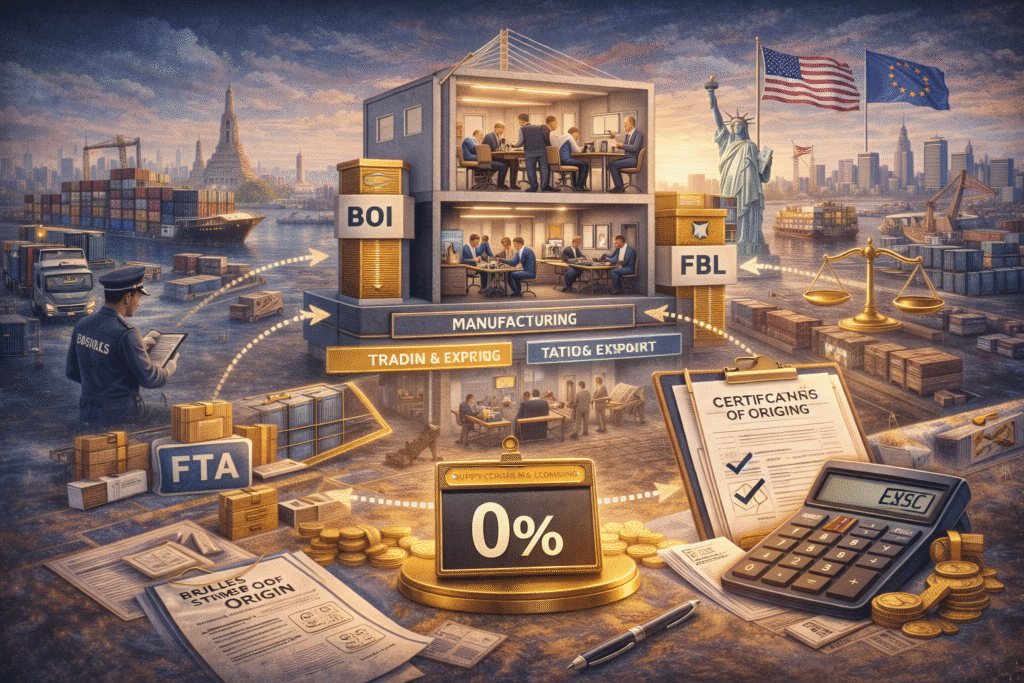
EP 10: How to Structure a Thailand Company for Legal Zero-Tariff Exports
Zero-tariff exports do not happen by accident.
They are not achieved by registering a company, applying for a license, or obtaining a Certificate of Origin alone.
They are the result of deliberate structural design.
After exploring Free Trade Agreements (FTAs), Rules of Origin, U.S. tariff realities, and common rejection risks, the final question becomes:
How should a Thailand company be structured to legally and defensibly achieve zero-tariff exports?
The answer lies in alignment.
1️⃣ Start with the Export Market — Not the Company Form
The most common structural mistake is starting with:
- “Should we register a Thai company?”
- “Should we apply for BOI?”
- “Do we need an FBL?”
Instead, begin with:
- Target export market
- Applicable tariff schedule
- FTA eligibility
- Origin requirements
- Trade remedy exposure
Only after understanding the tariff environment should the corporate structure be designed.
Tariff strategy must drive structure — not the other way around.
2️⃣ Align Corporate Structure with Regulatory Permission
A Thailand export structure typically involves one of the following:
- A standard Thai company
- A BOI-promoted entity
- An FBL-licensed foreign-majority company
- A hybrid structure combining manufacturing and trading functions
Each option affects:
- Foreign ownership
- Permitted business scope
- Tax treatment
- Operational flexibility
The structure must first be legally permitted, before it can be tariff-efficient.
3️⃣ Design Manufacturing Substance to Meet Rules of Origin
Zero-tariff qualification depends on:
- Regional Value Content (RVC)
- Change in Tariff Classification (CTC)
- Substantial transformation
This means the structure must ensure:
- Real production activity in Thailand
- Appropriate sourcing strategy
- Sufficient value addition
- Transparent cost allocation
A company that is legally registered but operationally shallow will fail origin tests.
Substance is not optional.
4️⃣ Integrate Supply Chain and Sourcing Strategy
Origin planning must align with:
- Raw material sourcing
- Regional supplier mix
- Transfer pricing model
- Cost accounting framework
If key inputs are sourced from non-FTA countries without sufficient transformation, zero-tariff eligibility may collapse.
Supply-chain design is as important as corporate registration.
5️⃣ Separate Functions Where Necessary
In some cases, an effective structure may include:
- A manufacturing entity (origin generation)
- A trading/export entity (commercial management)
- A service entity (regional coordination)
However, this must be structured carefully to ensure:
- Transfer pricing consistency
- Clear functional allocation
- Customs defensibility
- Regulatory compliance
Artificial separation without economic substance creates audit risk.
6️⃣ Ensure Documentation Mirrors Reality
Customs authorities increasingly examine:
- Production flow
- Supplier declarations
- Cost breakdowns
- Operational substance
- Corporate relationships
A defensible zero-tariff structure requires documentation systems that:
- Reflect actual operations
- Support origin calculations
- Align accounting and customs data
Paper compliance without operational consistency is fragile.
7️⃣ Stress-Test the Structure Before Exporting
Before shipments begin, investors should ask:
- Does this structure meet origin thresholds under the chosen FTA?
- What happens if sourcing changes?
- Can RVC calculations withstand audit review?
- Is HS classification validated?
- Is there exposure to trade remedies?
Testing the structure in advance prevents costly restructuring later.
Common Structural Errors
- Choosing BOI when FTA alignment was never evaluated
- Setting up a trading company expecting tariff benefits
- Ignoring U.S. or EU tariff modeling before production
- Treating Rules of Origin as a customs formality
- Designing structure after supply chain decisions are locked in
Zero-tariff failure is usually structural — not procedural.
The Strategic Framework
A legally defensible zero-tariff structure in Thailand requires alignment across:
- Target market tariff analysis
- Corporate licensing (BOI / FBL / standard registration)
- Manufacturing substance
- Sourcing and cost allocation
- Origin compliance
- Documentation integrity
- Trade remedy risk assessment
When these elements align, Thailand becomes a powerful export platform.
When they do not, the structure may be legal — but commercially inefficient or exposed to risk.
Final Takeaway
Zero-tariff exports are not a benefit you apply for.
They are a structure you build.
Thailand offers:
- A strong FTA network
- Regional integration
- Industrial depth
- Investment flexibility
But advantage only materializes when the corporate, operational, and trade elements are designed together.
How BRW Structures Export-Ready Companies
At BRW, we assist foreign investors by:
- Modeling tariff exposure before incorporation
- Determining whether BOI, FBL, or standard registration is appropriate
- Designing origin-compliant manufacturing structures
- Aligning sourcing, transfer pricing, and customs documentation
- Building defensible frameworks that withstand audit scrutiny
We do not simply register companies.
We structure export-ready platforms.
At BRW – Boonrawee Co., Ltd., we offer comprehensive legal, business, and property consulting services to support foreign investors and business owners looking to establish and grow in Thailand.
Our services include:
- Helping you understand and comply with Thai property and land ownership laws.
- Company registration and structuring for business and property purposes.
- Applying for BOI or IEAT promotions if land ownership or special privileges are needed.
- Drafting and reviewing land lease agreements to ensure legal protection.
- Finding suitable land or property locations that match your business needs (factory, office, or commercial spaces).
- Advising on site selection for business operations, including industrial estates, office buildings, and commercial zones.
- Providing architectural design and construction services for buildings, offices, and factories, including customized designs to meet specific business requirements.
- Coordinating with professional architects, engineers, and contractors to ensure your building project complies with Thai laws and standards.
📞 Contact BRW today for expert advice and a one-stop solution to establish your business and property in Thailand!
Read more from Zero-Tariff Export from Thailand
- EP 1: What Is “Zero-Tariff Export” and Why Investors Choose Thailand
- EP 2: Which Countries Import Goods from Thailand at 0% Tariff
- EP 3: Thailand FTA Network: Markets Where Zero-Tariff Access Is Possible
- EP 4: BOI, FBL, or FTA? Choosing the Right Path for Tariff-Free Exports
- EP 5: Rules of Origin Explained: How Products Qualify for 0% Import Duty
- EP 6: Can Trading or Service Companies Benefit from Zero-Tariff Exports?
- EP 7: Zero-Tariff Manufacturing in Thailand: Industries That Benefit Most
- EP 8: Exporting from Thailand to the U.S.: GSP, Tariffs, and Reality
- EP 9: Common Mistakes That Cause Zero-Tariff Benefits to Be Rejected
- EP 10: How to Structure a Thailand Company for Legal Zero-Tariff Exports