Zero-Tariff Export from Thailand
A Practical Guide for Foreign Investors
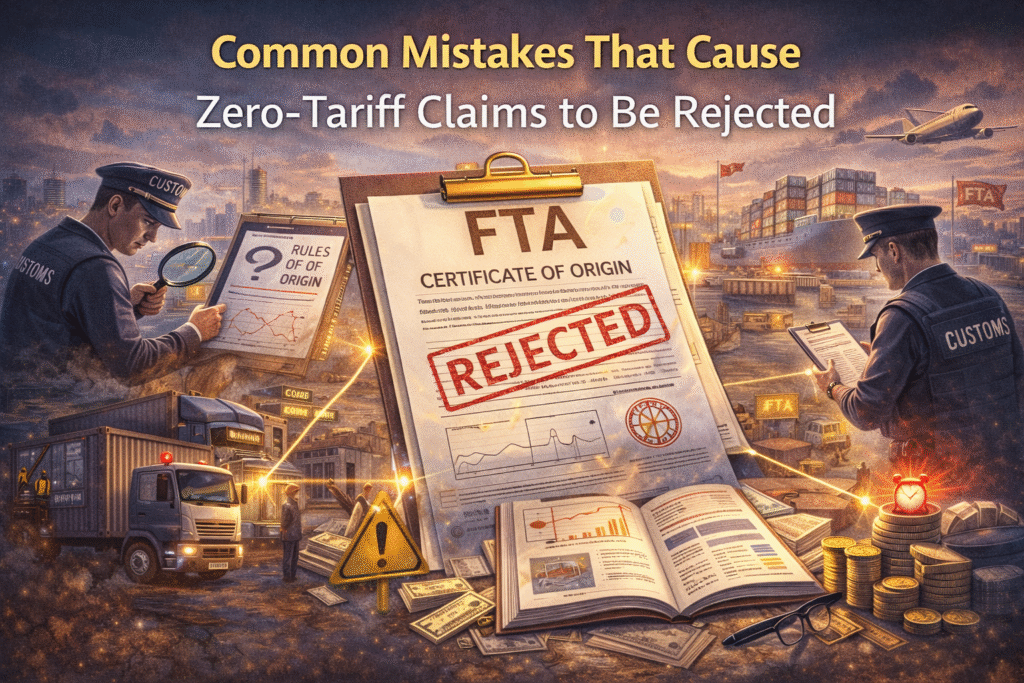
EP 9: Common Mistakes That Cause Zero-Tariff Benefits to Be Rejected
Many foreign investors assume that once a shipment clears customs under a Free Trade Agreement (FTA), the zero-tariff benefit is secure.
In reality, that is not always true.
Zero-tariff treatment can be:
- Rejected at the border
- Suspended during verification
- Revoked during post-clearance audits
- Subject to back-duty assessments and penalties
Understanding the most common causes of rejection is essential for any export-driven investment strategy.
Mistake #1: Assuming “Made in Thailand” Automatically Qualifies
Manufacturing location alone does not determine origin.
Customs authorities evaluate:
- Regional Value Content (RVC)
- Change in Tariff Classification (CTC)
- Sourcing patterns
- Production processes
If transformation is insufficient, the product may fail Rules of Origin tests — even if fully assembled in Thailand.
Mistake #2: Misclassifying HS Codes
Incorrect HS code classification can:
- Invalidate origin calculations
- Apply the wrong tariff rule
- Trigger retroactive adjustments
A product may qualify under one HS code but fail under another.
HS classification errors are among the most common reasons for FTA claim disputes.
Mistake #3: Inconsistent or Unsupported Value Calculations
For products relying on Regional Value Content thresholds:
- Cost allocation must be accurate
- Transfer pricing must be consistent
- Supporting documentation must match accounting records
If customs cannot verify calculations, preferential treatment may be denied.
Mistake #4: Using the Wrong FTA
A product may qualify under one agreement but not under another.
Each FTA has:
- Different origin rules
- Different calculation methods
- Different documentation standards
Selecting the wrong agreement can invalidate the entire claim.
Mistake #5: Insufficient Manufacturing Substance
Light assembly or minimal processing may not meet origin requirements.
Activities such as:
- Simple packaging
- Label changes
- Minor assembly
are often insufficient to satisfy transformation criteria.
Substance matters more than corporate form.
Mistake #6: Documentation That Does Not Reflect Reality
A Certificate of Origin is not immunity.
Customs authorities increasingly examine:
- Actual manufacturing operations
- Material sourcing records
- Supplier declarations
- Production flow
- Transfer pricing alignment
If documentation does not match operational substance, preferential status may be withdrawn.
Mistake #7: Designing Structure After Operations Begin
One of the most expensive errors is treating origin as an afterthought.
When companies:
- Set up operations first
- Source materials opportunistically
- Apply for FTA benefits later
they often discover that origin thresholds cannot be met without restructuring.
Origin strategy must be integrated at the design stage — not retrofitted.
The Real Risk: Post-Clearance Audits
Many investors assume that if shipments pass customs, the matter is closed.
However, customs authorities in multiple jurisdictions conduct:
- Post-clearance origin verification
- Retroactive audits
- Cross-border cooperation reviews
If origin cannot be substantiated:
- Back-duties may be imposed
- Interest and penalties may apply
- Future FTA eligibility may be suspended
Zero-tariff risk is often retrospective — and underestimated.
Strategic Takeaway
Zero-tariff rejection rarely results from one catastrophic mistake.
It usually results from:
- Small structural misalignments
- Weak documentation discipline
- Poor coordination between legal, accounting, and operations
The most resilient exporters treat origin planning as part of investment design — not customs administration.
How BRW Helps Prevent Rejection
At BRW, we assist foreign investors by:
- Stress-testing origin eligibility before production begins
- Reviewing HS classification and origin criteria
- Aligning sourcing models with RVC and CTC thresholds
- Integrating FBL, BOI, tax, and customs considerations
- Preparing defensible documentation frameworks
Zero-tariff success is not about obtaining a certificate.
It is about building a structure that withstands scrutiny.
At BRW – Boonrawee Co., Ltd., we offer comprehensive legal, business, and property consulting services to support foreign investors and business owners looking to establish and grow in Thailand.
Our services include:
- Helping you understand and comply with Thai property and land ownership laws.
- Company registration and structuring for business and property purposes.
- Applying for BOI or IEAT promotions if land ownership or special privileges are needed.
- Drafting and reviewing land lease agreements to ensure legal protection.
- Finding suitable land or property locations that match your business needs (factory, office, or commercial spaces).
- Advising on site selection for business operations, including industrial estates, office buildings, and commercial zones.
- Providing architectural design and construction services for buildings, offices, and factories, including customized designs to meet specific business requirements.
- Coordinating with professional architects, engineers, and contractors to ensure your building project complies with Thai laws and standards.
📞 Contact BRW today for expert advice and a one-stop solution to establish your business and property in Thailand!
Read more from Zero-Tariff Export from Thailand
- EP 1: What Is “Zero-Tariff Export” and Why Investors Choose Thailand
- EP 2: Which Countries Import Goods from Thailand at 0% Tariff
- EP 3: Thailand FTA Network: Markets Where Zero-Tariff Access Is Possible
- EP 4: BOI, FBL, or FTA? Choosing the Right Path for Tariff-Free Exports
- EP 5: Rules of Origin Explained: How Products Qualify for 0% Import Duty
- EP 6: Can Trading or Service Companies Benefit from Zero-Tariff Exports?
- EP 7: Zero-Tariff Manufacturing in Thailand: Industries That Benefit Most
- EP 8: Exporting from Thailand to the U.S.: GSP, Tariffs, and Reality
- EP 9: Common Mistakes That Cause Zero-Tariff Benefits to Be Rejected
- EP 10: How to Structure a Thailand Company for Legal Zero-Tariff Exports