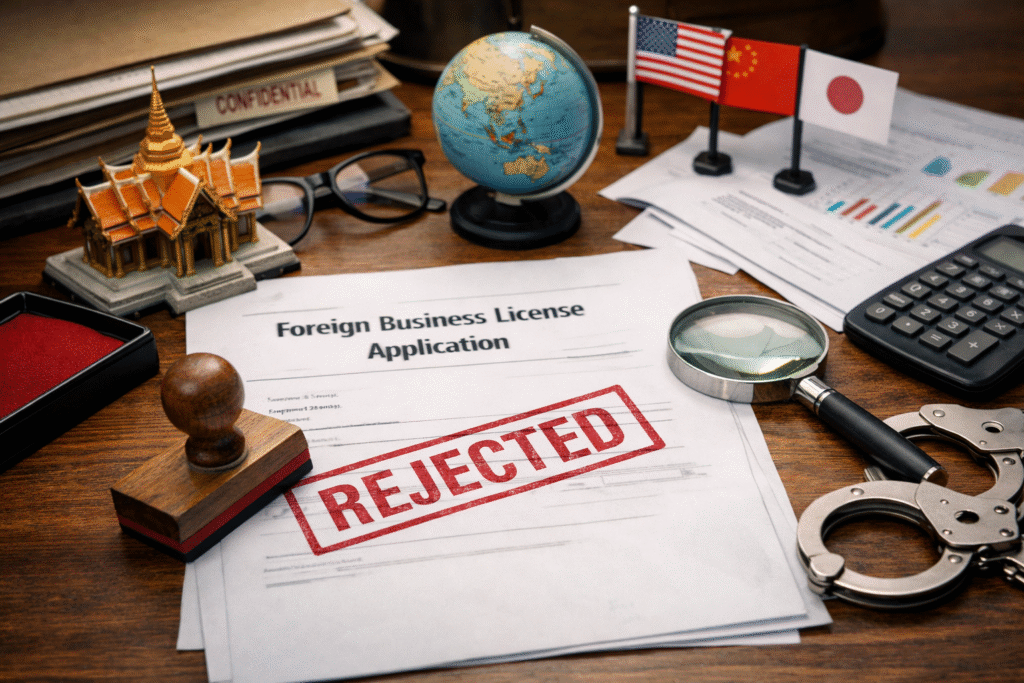
5 Reasons FBL Applications Get Rejected
(That Consultants Won’t Tell You)
Applying for a Foreign Business License (FBL) in Thailand looks straightforward on paper.
In reality, many applications fail—not because the business is illegal, but because of structural and credibility issues that are rarely disclosed by consultants.
Here are the five most common (and least discussed) reasons FBL applications get rejected.
1. The Business Model Is “Legally Allowed” but Not “Regulator-Convincing”
Many consultants focus only on whether the activity is technically permitted under the Foreign Business Act.
What regulators actually assess is:
- Does the Thai branch add real economic value?
- Or is it merely an extension of a foreign headquarters?
- Could this business be done by a Thai company instead?
If your application reads like:
“We do the same work as HQ, just located in Thailand”
it is already in trouble.
Reality:
FBL approval is discretionary. If officials are not convinced of the necessity of a foreign presence, rejection is likely—even if the activity is not prohibited.
2. The Revenue Flow Does Not Make Commercial Sense
One of the most common silent red flags:
- Thai branch shows expenses only
- Revenue is booked overseas
- Or income explanation is vague or inconsistent
Regulators will ask:
- Who pays the Thai entity?
- Why must the income be recognized outside Thailand?
- Is the branch genuinely conducting business—or just cost allocation?
If the revenue logic cannot withstand tax, transfer pricing, and commercial scrutiny, the application may stall indefinitely or be rejected outright.
3. Shareholder & Control Structure Looks “Too Clean” (or Too Complicated)
Ironically, both extremes are risky.
Red flags include:
- Complex offshore holding chains with no clear purpose
- Nominee-like structures disguised as “partners”
- Over-engineered diagrams copied from templates
- Control clearly remaining offshore while claiming Thai operational independence
Officials are trained to identify form over substance structures.
If they suspect:
- hidden control,
- risk avoidance,
- or regulatory arbitrage,
approval becomes very unlikely.
4. Supporting Documents Are Technically Correct—but Strategically Wrong
Most consultants ensure documents are:
- notarized
- translated
- apostilled
But that is only the minimum.
Applications fail because:
- business descriptions contradict financial projections
- job descriptions do not match staffing plans
- service scope is copied from generic templates
- explanations are legally correct but commercially unbelievable
Regulators read between the lines.
Consistency matters more than formatting.
5. No One Prepared the Client for the Interview (or Follow-Up Questions)
This is the most underestimated factor.
Many rejections occur after submission due to:
- unclear verbal explanations
- inconsistent answers between HQ and Thai representatives
- misunderstanding of why the FBL is needed at all
If the applicant cannot clearly explain:
- why Thailand,
- why now,
- why this structure,
confidence is lost—and once lost, rarely recovered.
The Hard Truth
FBL approval is not a checklist exercise.
It is a regulatory judgment call.
Authorities are not just approving documents—they are approving:
- credibility
- intent
- economic rationale
- long-term compliance risk
Final Thought
If an FBL application is prepared like a filing exercise, it will likely fail.
If it is prepared like an investment narrative supported by law, it stands a chance.
That difference is where most consultants fall short.
💼 How BRW Can Help You with Property and Business in Thailand
At BRW – Boonrawee Co., Ltd., we offer comprehensive legal, business, and property consulting services to support foreign investors and business owners looking to establish and grow in Thailand.
Our services include:
- Helping you understand and comply with Thai property and land ownership laws.
- Company registration and structuring for business and property purposes.
- Applying for BOI or IEAT promotions if land ownership or special privileges are needed.
- Drafting and reviewing land lease agreements to ensure legal protection.
- Finding suitable land or property locations that match your business needs (factory, office, or commercial spaces).
- Advising on site selection for business operations, including industrial estates, office buildings, and commercial zones.
- Providing architectural design and construction services for buildings, offices, and factories, including customized designs to meet specific business requirements.
- Coordinating with professional architects, engineers, and contractors to ensure your building project complies with Thai laws and standards.
📞 Contact BRW today for expert advice and a one-stop solution to establish your business and property in Thailand!